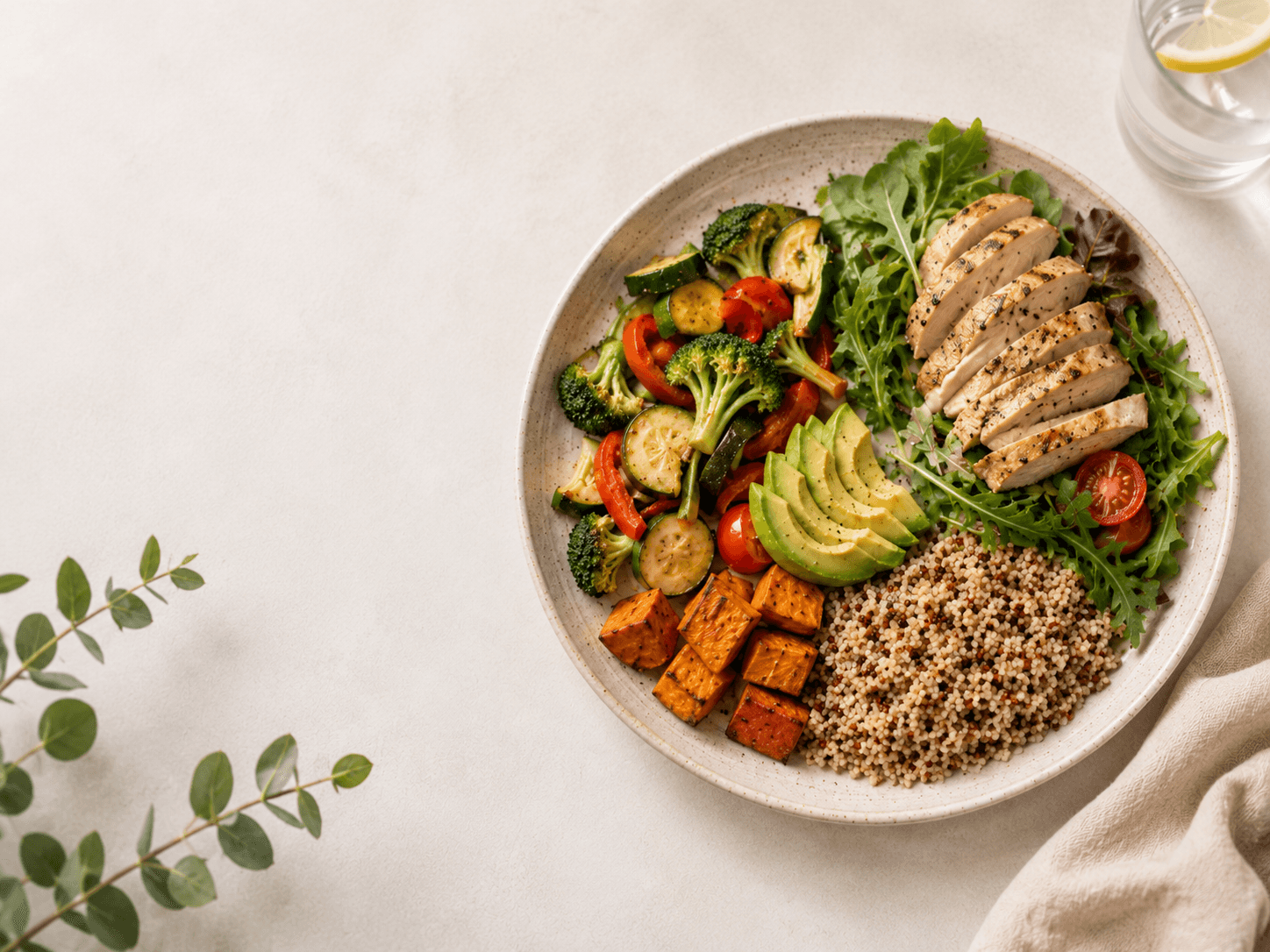
A balanced plate is simply a practical way to bring together the key components of a satisfying meal: protein, carbohydrate, healthy fats and vegetables. This approach can support nutritional adequacy, energy levels, fullness and long-term health while still leaving room for personal preferences, culture, convenience and enjoyment.
The Australian Dietary Guidelines recommend eating a variety of foods from the five core food groups, including vegetables and legumes, fruit, mostly wholegrain grain foods, protein-rich foods and dairy or suitable alternatives. A balanced-plate approach helps translate those broad recommendations into something you can use at an everyday meal [1,2].
Key takeaways
- Aim to include a source of protein, carbohydrate, healthy fat and vegetables in most main meals.
- As a practical guide, fill around half the plate with non-starchy vegetables, one-quarter with protein and one-quarter with carbohydrate, and include a small amount of healthy fat.
- Portion needs vary, so the plate model should be treated as a flexible starting point rather than a precise prescription.
- A balanced meal should also be enjoyable, satisfying and realistic enough to repeat.
What does a balanced plate look like?
A useful starting point for lunch and dinner is:
- ½ plate: non-starchy vegetables or salad
- ¼ plate: a protein-rich food
- ¼ plate: a nutritious carbohydrate food
- A small amount of healthy fat: included in cooking, dressing, toppings or naturally within the meal
It is important to remember that this is only a guide. The amount of food someone needs will depend on factors such as their body size, activity level, appetite, age, health conditions and personal goals.
A person who is highly active may need a larger carbohydrate portion. Someone with a smaller appetite may need a more compact meal. A mixed dish such as curry, pasta, soup or a burrito bowl may not fit neatly into separate sections at all.
The aim is not to make every plate look identical. It is to make sure the important components are present.
1. Start with a protein source
Protein provides amino acids needed for the growth, maintenance and repair of body tissues. It is particularly important for maintaining muscle mass, especially during ageing, periods of reduced food intake or intentional weight loss.
Protein can also contribute to fullness after eating. Research suggests that higher-protein meals may reduce short-term appetite, although the overall effect varies between individuals and does not mean that more protein is always better [3,4].
Protein options include:
- Chicken or turkey
- Fish and seafood
- Lean beef, lamb or pork
- Eggs
- Tofu or tempeh
- Lentils, chickpeas and beans
- Greek yoghurt or cottage cheese
- Reduced-fat cheese
- Nuts and seeds
Legumes can contribute both protein and carbohydrate, which is one reason they are so useful in balanced meals.
For many lunches and dinners, the protein component might occupy around one-quarter of the plate. However, the exact amount needed varies, and plant-based meals may combine several foods to provide enough protein.
Practical examples
- Grilled chicken in a salad bowl
- Salmon in a rice bowl
- Lean beef mince in a burrito bowl
- Tofu in a stir-fry
- Lentils and chickpeas in a curry
- Eggs and cottage cheese on wholegrain toast
2. Include a carbohydrate source
Carbohydrates are an important source of energy for the body and brain. They are found in foods such as grains, bread, rice, pasta, potatoes, legumes, fruit, milk and yoghurt.
Carbohydrates are sometimes unnecessarily removed from meals in an attempt to eat “healthily” or lose weight. However, removing them altogether can leave meals less satisfying, limit dietary variety and make it harder to meet fibre and nutrient needs.
The Australian Dietary Guidelines recommend choosing mostly wholegrain or high-fibre grain foods [1,2].
Nutritious carbohydrate choices include:
- Brown or basmati rice
- Wholegrain bread and wraps
- Rolled oats
- Wholemeal or high-fibre pasta
- Quinoa, barley or couscous
- Potato, sweet potato or corn
- Chickpeas, beans and lentils
- Fruit
- Milk and yoghurt
Wholegrain and higher-fibre carbohydrate foods usually provide more fibre, vitamins and minerals than heavily refined alternatives. Fibre may also support digestive health and contribute to feelings of fullness, although its effects on appetite vary depending on the type of fibre and the meal as a whole [5,6].
For many people, carbohydrate might occupy approximately one-quarter of the plate at lunch or dinner. This amount may need to increase or decrease depending on energy needs, activity, appetite and medical considerations.
3. Fill a generous part of the plate with vegetables
Non-starchy vegetables add fibre, vitamins, minerals, colour, flavour and volume to a meal.
Examples include:
- Broccoli and broccolini
- Cauliflower
- Capsicum
- Zucchini
- Mushrooms
- Tomato
- Cucumber
- Carrot
- Green beans
- Eggplant
- Cabbage
- Leafy greens
Vegetables are generally nutrient-dense and relatively low in kilojoules, which means they can add volume and nutritional value without making the meal excessively energy-dense [2].
A practical goal is to fill around half the plate with vegetables or salad. This does not need to happen at every meal, and the vegetables do not need to be plain or steamed.
They may be:
- Roasted with olive oil and herbs
- Stir-fried
- Added to a curry
- Mixed through pasta
- Served as a salad
- Added to wraps and sandwiches
- Blended into soup
- Cooked into a tray bake
Frozen vegetables are also a nutritious and convenient option. The best vegetables are usually the ones you enjoy and are able to use consistently.
4. Add a source of healthy fat
Fat is an essential nutrient. It helps the body absorb fat-soluble vitamins, forms part of cell membranes and contributes flavour and satisfaction to meals.
Healthy unsaturated fat sources include:
- Extra-virgin olive oil
- Avocado
- Nuts
- Seeds
- Tahini
- Natural peanut or other nut butter
- Oily fish such as salmon
Some meals already contain a significant fat source. For example, salmon, avocado, cheese, nuts and oil-based dressings all contribute fat. It is therefore not always necessary to add several fat-rich ingredients to the same meal.
Because fats are energy-dense, a relatively small amount can make a meaningful contribution. This does not make them “bad”; it simply means the amount required is often smaller than the vegetable, protein or carbohydrate components.
Examples:
- Olive oil used to roast vegetables
- Avocado added to a burrito bowl
- Tahini dressing over a chickpea salad
- Chia seeds added to yoghurt and fruit
- Peanut butter blended into a smoothie
Putting the plate together
A balanced plate might look like:
Mediterranean chicken bowl
- Protein: Grilled chicken
- Carbohydrate: Couscous
- Fat: Olive oil and feta
- Vegetables: Tomato, cucumber, capsicum and zucchini
Teriyaki salmon bowl
- Protein: Salmon
- Carbohydrate: Rice
- Fat: Naturally provided by the salmon, with optional sesame seeds
- Vegetables: Cabbage, carrot, cucumber and edamame
Vegetarian curry
- Protein: Tofu and lentils
- Carbohydrate: Rice and lentils
- Fat: Light coconut milk or a small amount of oil
- Vegetables: Broccoli, capsicum, spinach and zucchini
Beef burrito bowl
- Protein: Lean beef mince
- Carbohydrate: Rice and black beans
- Fat: Avocado
- Vegetables: Lettuce, tomato, capsicum and onion
Mixed meals do not need to be separated into neat sections. A stir-fry, pasta dish, curry or tray bake can still be balanced when all four components are included.
What about breakfast?
Breakfast may not resemble the traditional plate model, but the same principles can still be applied.
Try combining:
- Protein
- Carbohydrate
- Healthy fat
- Fruit or vegetables
For example:
Yoghurt bowl
- High-protein yoghurt
- Mixed berries
- Granola
- Chia seeds
Protein porridge
- Rolled oats
- Milk
- Protein powder or Greek yoghurt
- Apple
- Walnuts
Savoury toast
- Wholegrain toast
- Eggs
- Cottage cheese
- Spinach, mushrooms or tomato
A balanced breakfast does not need to be large, but it should ideally provide enough substance to support energy and manage hunger until the next planned meal.
Does every meal need to be perfectly balanced?
No.
Nutrition is shaped by what you eat over time, not by one individual meal. Some meals may contain fewer vegetables. Others may be higher in carbohydrate, fat or energy. Social meals, takeaway foods and convenience options can still form part of a balanced overall eating pattern.
The plate method is most useful as a regular foundation, not a rule that needs to be followed perfectly.
A helpful question is:
What could I add to make this meal more complete?
For example:
- Add chicken, tuna, tofu or beans to a salad.
- Add frozen vegetables to pasta or curry.
- Add yoghurt and fruit alongside toast.
- Add rice or potato to a meal that contains protein and vegetables but lacks carbohydrate.
- Add avocado, olive oil, nuts or seeds when a meal has very little fat.
This “add rather than restrict” approach is often more practical than focusing only on what needs to be removed.
A balanced plate is not one-size-fits-all
The half-vegetable, quarter-protein and quarter-carbohydrate model is a useful visual guide, but it does not account for every person’s needs.
Your ideal portions may differ if you:
- Have high energy requirements
- Undertake regular endurance or strength training
- Are pregnant or breastfeeding
- Have diabetes or another medical condition
- Have had bariatric surgery
- Experience a reduced appetite
- Follow a vegetarian or vegan diet
- Are working toward a specific body-composition goal
- Have food allergies, intolerances or gastrointestinal concerns
In these situations, individualised advice from an Accredited Practising Dietitian may be helpful.
The bottom line
A balanced meal does not need to be complicated.
Start by asking whether the meal contains:
- A meaningful source of protein
- A nutritious carbohydrate food
- A source of healthy fat
- A generous amount of vegetables or, at breakfast, fruit or vegetables
From there, adjust the portions according to your appetite, preferences, lifestyle and individual needs.
The goal is not to build the perfect plate. It is to create meals that are nourishing, satisfying and practical enough to work in real life.
A note on scope
This article provides general nutrition information and is not a substitute for individual medical or dietetic advice.
References
- National Health and Medical Research Council (2013). NHMRC, Canberra. — Australian Dietary Guidelines
- Australian Government Department of Health and Aged Care. — Australian Guide to Healthy Eating and the Five Food Groups
- Hansen TT, et al. (2021). Nutrients, 13(9):3193. — Are dietary proteins the key to successful body-weight management? A systematic review of studies in people with overweight and obesity
- Kohanmoo A, et al. (2020). Physiology & Behavior. — Effect of short- and long-term protein consumption on appetite and appetite-regulating gastrointestinal hormones: a systematic review and meta-analysis
- Clark MJ, Slavin JL (2013). Journal of the American College of Nutrition, 32(3):200–211. — The effect of fibre on satiety and food intake: a systematic review
- Salleh SN, et al. (2019). Foods, 8(1):15. — Unravelling the effects of soluble dietary fibre supplementation on energy intake and perceived satiety in healthy adults: a systematic review and meta-analysis