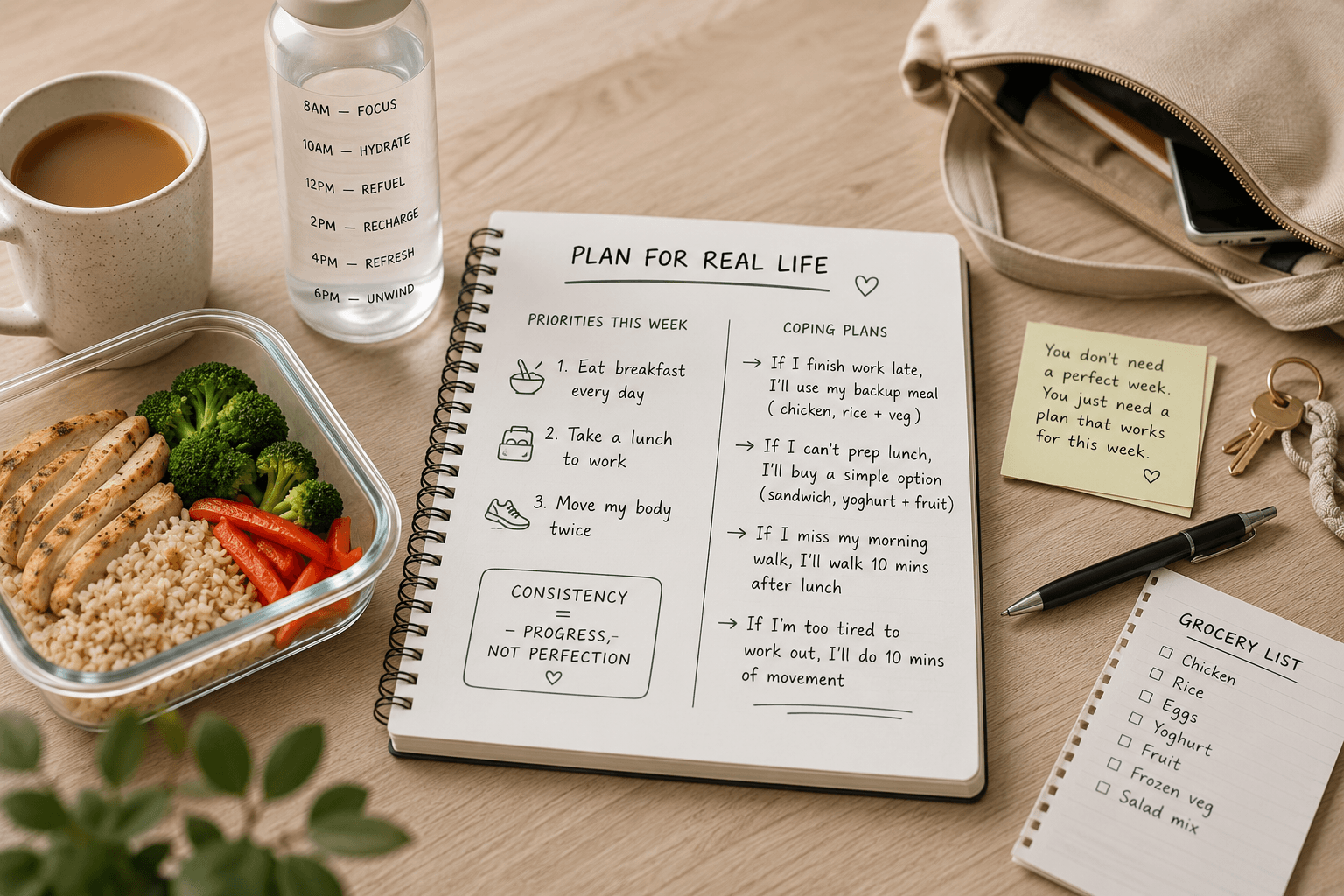
The real challenge is what happens when work becomes demanding, appointments pile up, travel interrupts the usual routine or an unexpected event changes the plan.
Consistency does not mean following the same routine perfectly every day. It means having enough structure to keep moving in a helpful direction, while being flexible when your time, energy and circumstances change.
Planning research distinguishes between action planning, which identifies when, where and how a behaviour will happen, and coping planning, which anticipates barriers and decides how you will respond. Both can help turn good intentions into practical action. [1–3]
Key takeaways
- Consistency does not require perfect adherence to one ideal routine.
- Plan for predictable barriers before they occur.
- Prioritise the few behaviours that matter most during demanding weeks.
- Keep simple fallback meals and lower-effort versions of important habits available.
- A disrupted meal or missed workout does not require compensation or a complete restart.
- Review what happened, adjust the plan and return at the next realistic opportunity.
Why routines often disappear during busy weeks
Most people do not begin the week intending to skip meals, rely heavily on takeaway or miss planned movement.
These things often happen because the original plan depended on conditions that were no longer available.
For example:
- Dinner required 45 minutes of preparation, but work finished late.
- Lunch was meant to be prepared in the morning, but the morning became rushed.
- Exercise was scheduled for the evening, but energy was consistently low by then.
- The shopping list assumed there would be time to cook every night.
- There was no backup meal available when plans changed.
The issue is not necessarily a lack of motivation. The plan may simply have been designed for an ideal week rather than a realistic one.
A more resilient plan includes alternatives for the times when the preferred option is not possible.
What does consistency actually mean?
Consistency is often confused with perfection.
A perfection-based approach may define success as:
- preparing every meal from scratch
- completing every planned workout
- avoiding all unplanned foods
- following the routine seven days per week
- never ordering takeaway
Under this definition, one disrupted meal or missed session can make the entire week feel unsuccessful.
A more useful definition is:
Consistency means returning to helpful behaviours repeatedly over time, even when they cannot be completed perfectly.
That might look like:
- cooking twice rather than five times
- completing a shorter strength session
- buying a balanced supermarket meal instead of cooking
- adding vegetables to a takeaway meal
- packing a sandwich rather than preparing an elaborate lunch
- returning to your usual breakfast after a disrupted day
The aim is not to make every week identical. It is to prevent a temporary disruption from becoming a complete abandonment of the routine.
1. Choose your highest-priority behaviours
During a calm week, you may have the capacity to focus on several habits at once.
During a demanding week, trying to preserve every part of the usual routine can become overwhelming. Instead, choose two or three behaviours that provide the most useful foundation.
These might include:
- eating regular meals
- including protein at main meals
- having vegetables with dinner
- preparing lunch for work
- carrying a water bottle
- completing two short movement sessions
- keeping suitable food available at home
For example, your priorities for a busy week might be:
- Eat breakfast before leaving home.
- Take a prepared or purchased lunch to work.
- Complete two short walks.
Other behaviours can temporarily become optional.
This is not giving up. It is directing limited time and energy towards the actions that matter most.
2. Build a realistic plan, not an ideal one
An ideal plan describes what you might do when time, energy and motivation are all readily available.
A realistic plan considers what you are likely to manage during an ordinary or busy week.
Ideal plan
- Cook dinner from scratch five nights per week.
- Prepare a different lunch every evening.
- Complete four one-hour exercise sessions.
More realistic plan
- Cook three dinners and use leftovers twice.
- Prepare simple lunches or use suitable supermarket options.
- Complete two full sessions and one shorter session.
The realistic plan is not necessarily less effective. It may be more useful because it can be repeated.
When planning the week, ask:
- Which days are likely to be difficult?
- How much time will I genuinely have?
- When is my energy usually highest?
- Which meals can be repeated?
- What can be prepared once and used more than once?
- Which tasks can be simplified?
3. Use action plans and coping plans
An action plan specifies what you intend to do.
For example:
On Sunday afternoon, I will choose three dinners and add the ingredients to my shopping list.
A coping plan specifies what you will do if something interferes.
For example:
If I finish work late, I will use cooked chicken, microwave rice and frozen vegetables instead of preparing the planned recipe.
Research suggests that coping plans can be especially useful when combined with action plans because they prepare a response to predictable barriers before they occur. [2,3]
Other examples include:
- If I cannot prepare lunch, I will buy a sandwich, yoghurt and fruit.
- If I miss my morning walk, I will walk for 10 minutes after lunch.
- If I am too tired for the full workout, I will complete the first three exercises.
- If I am travelling, I will identify a few suitable breakfast options in advance.
The alternative does not need to be identical to the original plan. It only needs to keep some connection with the intended behaviour.
4. Create a minimum version
A minimum version is the smallest useful form of a behaviour that you can manage during a difficult period.
- Preferred version: Cook a balanced dinner from scratch. Minimum version: Assemble chicken, microwave rice and bagged salad.
- Preferred version: Complete a 45-minute workout. Minimum version: Complete 10–15 minutes.
- Preferred version: Prepare lunch the night before. Minimum version: Pack a sandwich, yoghurt and fruit.
- Preferred version: Walk for 30 minutes. Minimum version: Walk for 10 minutes.
- Preferred version: Complete a full weekly meal plan. Minimum version: Choose three dinners and one backup meal.
The minimum version is not intended to replace the preferred routine indefinitely. It provides a bridge when the full version is unrealistic.
It also helps challenge all-or-nothing thinking. A shorter or simpler action can still be worthwhile.
5. Keep a few fallback meals available
A fallback meal is a quick, reliable option that requires minimal preparation or decision-making.
It does not need to be completely homemade or different every time. Its purpose is to make an adequate meal easier than having no plan.
Breakfast ideas
- High-protein yoghurt, fruit, granola and chia seeds
- Wholegrain toast with eggs
- A protein smoothie with milk, fruit and peanut butter
- Overnight oats
- Cereal with milk, yoghurt and fruit
Lunch ideas
- A wholegrain wrap with chicken, salad and avocado
- Tuna, microwave rice and a salad kit
- Soup with wholegrain toast and a protein-rich side
- A sandwich with fruit and yoghurt
- Dinner leftovers
Dinner ideas
- Barbecue chicken, microwave rice and bagged salad
- Frozen fish, frozen vegetables and potatoes
- Eggs on toast with spinach and tomato
- Filled pasta with tomato-based sauce and frozen vegetables
- Tinned beans, rice, salsa and pre-cut vegetables
- A balanced frozen meal with extra vegetables
A useful fallback meal generally includes:
- a protein source
- a carbohydrate source
- some fat
- vegetables or fruit where practical
Convenience foods are not automatically nutritionally poor. Frozen vegetables, canned legumes, microwave grains, salad kits and ready-cooked proteins can make balanced meals much easier during demanding weeks.
6. Plan enough, but not everything
Meal planning does not need to mean assigning a different recipe to every day.
Observational research has found associations between meal planning and greater food variety and diet quality, although this cannot prove that meal planning itself caused those outcomes. Meal planning has also been associated with better results in some behavioural weight-management programs. [4,5]
A flexible weekly plan might include:
- three planned dinners
- one meal that creates leftovers
- one quick meal
- one freezer or pantry meal
- one flexible night for takeaway, dining out or changed plans
For example:
- Monday: Mediterranean chicken tray bake
- Tuesday: Leftovers
- Wednesday: Teriyaki salmon rice bowl
- Thursday: Eggs on toast with vegetables
- Friday: Flexible meal
- Saturday: Beef burrito bowls
- Sunday: Freezer meal or leftovers
This provides direction without assuming every day will unfold exactly as expected.
7. Prepare useful components
You do not need to spend an entire Sunday preparing every meal for the week.
Selective preparation may be more sustainable.
Useful tasks might include:
- cooking extra chicken or tofu
- preparing additional rice
- washing fruit
- chopping one or two vegetables
- boiling eggs
- making overnight oats
- preparing one freezer-friendly meal
- packing lunch while cleaning up dinner
Ask:
Which single task would make the coming week easier?
Preparing one useful component may be more valuable than spending hours cooking meals you may not want later in the week.
8. Reduce unnecessary decisions
Decision-making can become more difficult when you are tired, stressed or rushed.
You can reduce the number of decisions required by:
- repeating breakfast or lunch
- keeping a standard shopping list
- rotating through a small collection of simple dinners
- choosing meals before the week begins
- keeping a written list of fallback meals
- storing useful foods where they are easy to see
Eating the same breakfast several times per week is not a problem if your overall eating pattern remains varied.
Repetition can make routines easier and preserve mental energy for other decisions.
9. Let takeaway fit into the plan
Staying consistent does not require avoiding takeaway or restaurant meals.
These options may be useful when time, cooking facilities or energy are limited.
Rather than searching for a perfect option, look for a reasonable meal that includes some of the following:
- a clear protein source
- a carbohydrate source
- vegetables or salad
- a portion likely to be satisfying
Examples might include:
- a chicken souvlaki plate with salad and pita
- a burrito bowl with beans and vegetables
- sushi with edamame
- a stir-fry with rice
- grilled fish with potatoes and salad
- a burger with salad and a chosen side
Sometimes the meal will not be particularly balanced, and that is okay. One meal does not define the overall eating pattern.
Avoid compensating by skipping the next meal or severely restricting food the following day. Return to your usual routine at the next opportunity.
10. Adjust movement rather than abandoning it
Busy weeks often interrupt exercise because the planned session no longer fits.
Instead of asking whether you can complete the entire workout, ask what version remains possible.
Options include:
- shortening the session
- reducing the number of exercises
- walking during a lunch break
- completing a home workout
- splitting movement into shorter periods
- moving the session to another day
Planning interventions appear to produce small but meaningful improvements in physical activity, although results vary between studies and populations. [6]
For example:
This week I will complete two 20-minute sessions instead of three 45-minute sessions.
That is still a plan.
Respond to disruption without “starting again”
A busy week may include more takeaway, fewer vegetables, missed exercise or unplanned eating.
This does not mean that all previous progress has been lost.
A lapse is a temporary departure from the intended behaviour. It does not automatically become a long-term return to previous habits. Behaviour-change research supports viewing lapses as opportunities to learn and re-engage rather than as proof of failure. [7,8]
After disruption, avoid:
- waiting until Monday
- skipping meals to compensate
- attempting an extreme reset
- adding excessive exercise
- labelling the week as ruined
- trying to change everything at once
Instead, identify the next useful action.
That might be:
- eating your usual breakfast
- packing lunch
- buying groceries
- going for a short walk
- preparing one dinner
- rescheduling a missed workout
Returning at the next opportunity prevents one disrupted event from gaining unnecessary momentum.
A simple busy-week plan
Before a demanding week begins, decide:
- My priorities: Which two or three behaviours matter most?
- My meals: Which days require quick or prepared options?
- My fallback meals: Which meals can I keep in the freezer, pantry or fridge?
- My likely barrier: What is most likely to interfere with the plan?
- My coping plan: If __________ happens, then I will __________.
- My minimum movement plan: What is the smallest useful version I can maintain?
- My return plan: If the week becomes completely disrupted, which behaviour will I return to first?
Questions to ask at the end of the week
Reflection can help improve the next plan.
Ask:
- What worked despite the disruption?
- Which meals were easiest?
- Where did the plan become unrealistic?
- Which barrier occurred more than once?
- Did I have enough quick options available?
- Was my minimum plan manageable?
- What is one change that would make next week easier?
The purpose is not to judge your performance. It is to gather information.
The bottom line
Staying consistent during busy or disrupted weeks is not about forcing an ideal routine into circumstances where it no longer fits.
It is about creating a plan with enough flexibility to adapt.
A resilient routine includes:
- clear priorities
- realistic expectations
- action and coping plans
- quick meals
- convenient ingredients
- minimum versions of important habits
- a simple way to return after disruption
Some weeks will involve more planning, cooking and movement than others. The goal is not to eliminate those differences.
The goal is to maintain enough structure, and return often enough, that a difficult week remains a temporary disruption rather than the end of the routine.
A note on scope
This article provides general health and nutrition information and is not a substitute for individual medical, dietetic or psychological advice.
References
- Bailey RR (2019). American Journal of Lifestyle Medicine, 13(6):615–618. — Goal setting and action planning for health behavior change
- Hagger MS, Luszczynska A (2014). Applied Psychology: Health and Well-Being, 6(1):1–47. — Implementation intention and action planning interventions in health contexts: state of the research and proposals for the way forward
- Caudroit J, Stephan Y, Le Scanff C (2014). British Journal of Health Psychology, 19(2):404–417. — Social cognitive determinants of physical activity among retired older individuals: an application of the Health Action Process Approach
- Ducrot P, Méjean C, Aroumougame V, et al. (2017). International Journal of Behavioral Nutrition and Physical Activity, 14:12. — Meal planning is associated with food variety, diet quality and body weight status in a large sample of French adults
- Hayes JF, Balantekin KN, Fitzsimmons-Craft EE, et al. (2021). Annals of Behavioral Medicine, 55(1):14–23. — Greater average meal planning frequency predicts greater weight loss outcomes in a worksite-based behavioural weight-loss program
- Peng S, Othman AT, Yuan F, Liang J (2022). International Journal of Environmental Research and Public Health, 19(12):7337. — The effectiveness of planning interventions for improving physical activity in the general population: a systematic review and meta-analysis of randomised controlled trials
- DiClemente CC (2022). Journal of Health Service Psychology, 48:59–68. — Relapse on the road to recovery: learning the lessons of failure on the way to successful behavior change
- Lawlor ER, Islam N, Bates S, et al. (2020). Obesity Reviews, 21(7):e13013. — Third-wave cognitive behaviour therapies for weight management: a systematic review and network meta-analysis