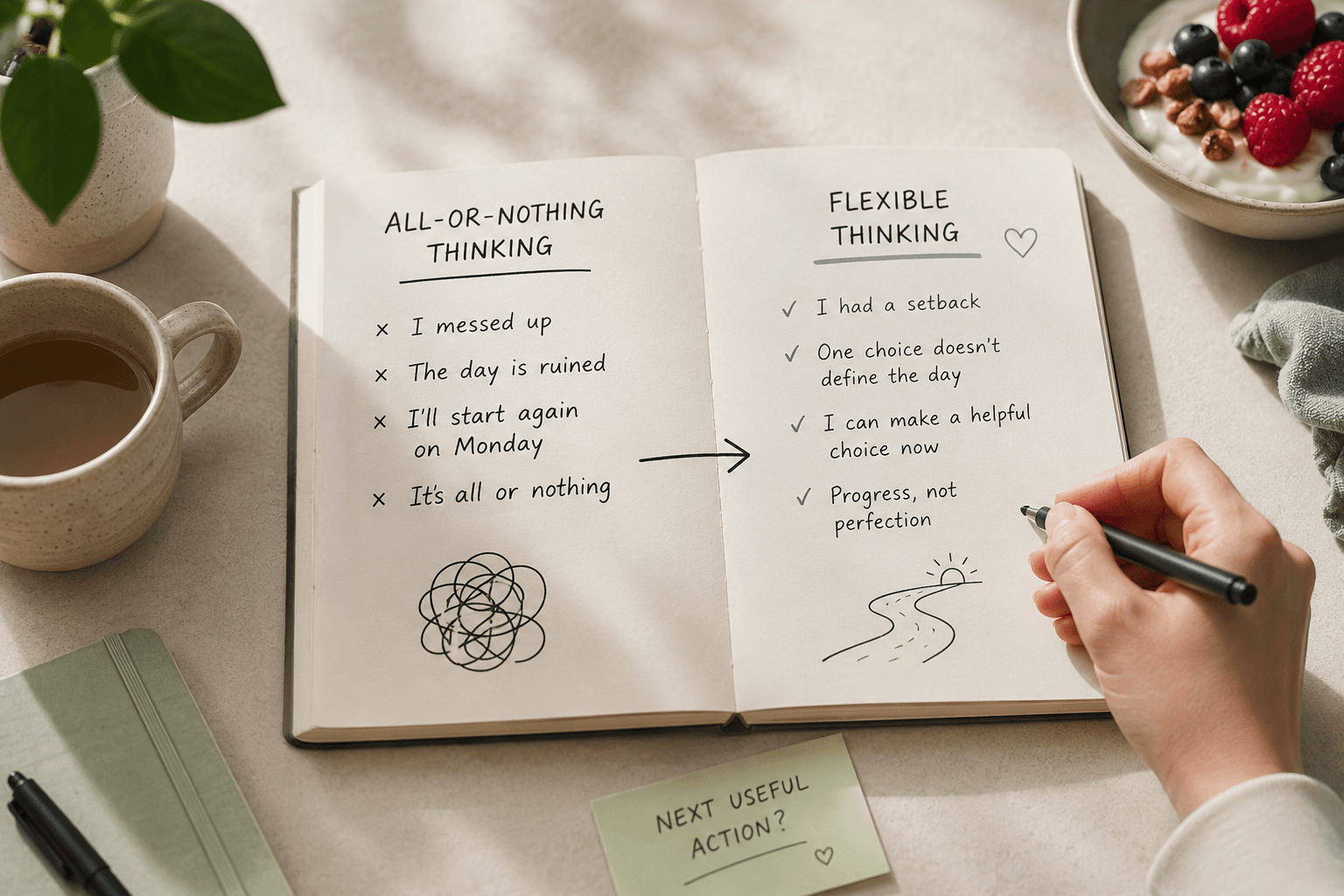
An unplanned snack may create the feeling that the entire day has been “ruined.” One missed workout can become a reason to abandon exercise for the rest of the week. A restaurant meal may lead to the decision to “start again on Monday.”
This is known as all-or-nothing thinking, or dichotomous thinking. It involves viewing choices in opposing categories such as good or bad, success or failure, with little room for anything in between.
Research has linked eating-related dichotomous thinking with rigid dietary restraint and weight regain, although much of this evidence is observational and cannot prove direct cause and effect. [1]
Moving beyond this pattern does not mean abandoning goals, structure or accountability. It means replacing fragile, perfection-based rules with a more flexible approach that can continue when life does not go exactly to plan.
Key takeaways
- All-or-nothing thinking treats anything less than perfect adherence as failure.
- One meal, snack or missed workout does not determine the overall outcome.
- Flexible plans are usually easier to maintain than rigid rules.
- Focus on the next useful action rather than waiting for a new day or week.
- Consistency is built by returning to helpful behaviours, not by avoiding every disruption.
What does all-or-nothing thinking look like?
All-or-nothing thinking can appear in many areas of health behaviour.
With food, it may sound like:
- “I ate dessert, so today is already ruined.”
- “If I cannot follow the plan exactly, there is no point.”
- “This food is bad, so I should never eat it.”
- “I was good all week and bad on the weekend.”
With exercise, it may sound like:
- “A 15-minute walk is not worth doing.”
- “I missed Monday’s workout, so I will restart next week.”
- “If I cannot complete the full session, it does not count.”
With weight management, it may sound like:
- “My weight increased this week, so nothing is working.”
- “If I regain some weight, I am back at the beginning.”
These thoughts can feel motivating at first because they create clear rules. The problem is that they also make the plan fragile. When success requires perfect adherence, even a small disruption can feel like total failure.
Structure is helpful. Rigidity is not.
Structure can support consistency.
It may involve:
- planning meals
- following portion guidance
- scheduling exercise
- monitoring progress
- keeping useful foods available
Rigidity occurs when these strategies become inflexible rules.
For example:
Structured approach:
“I usually prepare lunch for work because it helps me eat regularly.”
Rigid approach:
“If I do not prepare the exact lunch I planned, I have failed.”
Research suggests that flexible approaches to eating may be associated with more favourable weight-management and psychological outcomes, while rigid control has been associated with greater food preoccupation and disordered-eating symptoms. These relationships are complex, but the overall message is useful: structure should guide you without making one imperfect choice feel catastrophic. [2–4]
Notice extreme language
All-or-nothing thoughts often contain words such as:
- always
- never
- perfect
- ruined
- failed
- good
- bad
- pointless
For example:
“I completely ruined the day.”
A more accurate version might be:
“I ate more than I intended at one meal.”
The second statement does not dismiss what happened. It simply describes it without turning one event into a judgement about the entire day.
When you notice an extreme thought, ask:
- Is this completely true?
- Am I treating one event as though it represents everything?
- What would a more accurate version sound like?
- What exists between perfect success and total failure?
Replace either-or thinking with a continuum
Health behaviours are rarely either perfect or pointless.
Imagine your planned strength workout includes six exercises.
- Six exercises may be the full session.
- Four exercises may still be useful.
- Two exercises may help maintain the routine during a busy day.
- A short walk may still provide movement, even if it is not the planned workout.
These options are not identical, but they are not all the same as doing nothing.
The same applies to meals.
A meal does not need to be perfect to be improved. A takeaway meal might be made more balanced by adding salad or vegetables. A simple dinner of eggs, toast and frozen vegetables may still provide protein, carbohydrate, fat and fibre.
A useful question is:
What would make this choice slightly more supportive of my goals?
Separate one choice from the rest of the day
One of the most common all-or-nothing patterns is allowing one decision to control everything that follows.
For example:
“I ate cake at morning tea, so there is no point having the lunch I packed.”
The cake and lunch are separate decisions.
Eating cake does not require skipping lunch, overeating later or abandoning the rest of the day. You can still eat your usual lunch when you are hungry.
The same principle applies elsewhere:
- An unplanned snack does not determine dinner.
- A restaurant meal does not determine breakfast the next day.
- A missed workout does not determine the rest of the week.
- A higher weight reading does not make today’s habits pointless.
Bring your attention back to the next decision rather than judging the entire day.
Focus on the next useful action
All-or-nothing thinking often leads to delayed restarts:
- tomorrow
- Monday
- next month
- after the holiday
- when work becomes quieter
Waiting for a symbolic fresh start can turn a short disruption into a much longer one.
Instead, ask:
What is the next useful action available to me?
It might be:
- eating your usual next meal
- drinking water
- packing lunch
- buying groceries
- going for a short walk
- completing part of the planned workout
- returning to your usual bedtime
The next action does not need to compensate for what happened. It simply reconnects you with the direction you intended to take.
Avoid compensating for perceived mistakes
After eating more than intended, people may try to compensate by skipping meals, cutting out carbohydrates, fasting or exercising excessively.
Although this may feel like regaining control, it can reinforce the idea that eating needs to be punished and may contribute to cycles of restriction and overeating.
A more balanced response is to return to your usual eating pattern.
That may mean:
- eating the next meal when you are hungry
- including protein, carbohydrate, fat and vegetables
- avoiding an extreme “reset”
- reflecting on what happened once emotions have settled
If compensatory eating or exercise behaviours are frequent or distressing, support from a dietitian, psychologist or eating-disorder professional may be appropriate.
Replace judgement with curiosity
Self-criticism can feel like accountability, but it rarely explains why something happened.
Instead of:
“I have no discipline.”
try asking:
- Was I very hungry?
- Had I skipped a meal?
- Was I tired or stressed?
- Was the plan too restrictive?
- Did I have a realistic alternative available?
- What would make this easier next time?
For example:
“I have no self-control around takeaway.”
could become:
“I tend to order takeaway when I arrive home late and there is no quick meal available.”
The second statement identifies a practical solution: keep one or two fallback meals available.
Use flexible targets
A single fixed target can make anything less feel unsuccessful.
Where appropriate, use a target range or a minimum version.
Exercise
Instead of:
Complete four one-hour sessions every week.
Try:
Aim for three sessions, with two as the minimum during busy weeks.
Meal preparation
Instead of:
Cook dinner every night.
Try:
Cook three dinners, use leftovers twice and keep quick options available.
Movement
Instead of:
A workout only counts if it lasts 45 minutes.
Try:
Complete the full session when possible and use a shorter version when needed.
Flexible targets preserve direction while allowing for normal variation.
A lapse is not the same as giving up
A lapse is a temporary departure from the intended behaviour.
Examples include:
- missing one workout
- eating more takeaway during a busy week
- forgetting to prepare lunch
- eating beyond comfortable fullness at a social event
The lapse itself may have only a small effect. The response to it often matters more.
All-or-nothing thinking may turn a lapse into:
“I have failed, so there is no point continuing.”
A more flexible response is:
“That did not go as planned. What can I do next?”
Long-term behaviour change involves disruption, adjustment and return. It is rarely a perfectly uninterrupted process. [5]
Review patterns, not isolated moments
Progress should be assessed over an appropriate timeframe.
One meal does not define your diet. One missed workout does not define your activity level. One weight reading does not define your progress.
Instead, consider the broader pattern:
- What has improved over the past month?
- Which behaviours are happening more often?
- What has become easier?
- Are setbacks becoming shorter?
- Am I returning to my routine more quickly?
Progress may include recovering from disruptions more effectively, not only avoiding them.
Use more neutral language around food
Foods differ in their nutrient content and energy density, but eating them does not make someone morally good or bad.
Instead of labelling food as “good” or “bad,” it may be more useful to describe it as:
- higher or lower in protein
- higher or lower in fibre
- more or less energy-dense
- eaten regularly or occasionally
- chosen for nutrition, convenience or enjoyment
A flexible eating pattern can include foods chosen primarily for nourishment and foods chosen primarily for enjoyment.
A practical reframing exercise
When you notice an all-or-nothing thought, work through these steps.
- Identify the thought: “I missed my workout, so the week is ruined.”
- Describe what actually happened: “I missed Tuesday’s workout because work finished late.”
- Identify the middle ground: “I can move the workout to Thursday or complete a shorter session.”
- Choose the next action: “I will complete a 20-minute session tomorrow morning.”
This does not pretend the missed session was irrelevant. It simply prevents one event from controlling the rest of the week.
Common thoughts and more flexible alternatives
- All-or-nothing thought: “I ate more than planned, so I may as well keep eating.” More flexible alternative: “I ate more than planned. I can pause and decide what I need now.”
- All-or-nothing thought: “I missed the gym, so today was a failure.” More flexible alternative: “I missed the gym, but I can reschedule the session or move in another way.”
- All-or-nothing thought: “If I cannot do it properly, there is no point.” More flexible alternative: “A smaller version may still be useful.”
- All-or-nothing thought: “I will start again on Monday.” More flexible alternative: “I can take one useful action at my next meal.”
- All-or-nothing thought: “I gained weight, so I am back at the beginning.” More flexible alternative: “I am not back at the beginning. I still have the knowledge and skills I have developed.”
When additional support may help
All-or-nothing thinking is common during attempts to change health behaviours. However, professional support may be important when it is accompanied by:
- frequent binge eating
- severe food restriction
- purging or compensatory exercise
- intense guilt or anxiety around food
- significant body-image distress
- repeated cycles of extreme dieting
- feeling unable to control eating behaviours
An Accredited Practising Dietitian, psychologist, GP or eating-disorder professional can help determine what support is appropriate.
The bottom line
All-or-nothing thinking makes consistency fragile because anything less than perfection can feel like failure.
A more sustainable approach allows for:
- imperfect meals
- shorter workouts
- social eating
- busy weeks
- missed plans
- gradual progress
- returning without punishment
Instead of asking:
“Did I follow the plan perfectly?”
ask:
“What went well, what made things difficult and what is the next useful action?”
Long-term consistency is not the absence of disruption. It is the ability to return without turning one imperfect moment into a reason to give up.
A note on scope
This article provides general health and nutrition information and is not a substitute for individual medical, dietetic or psychological advice.
References
- Palascha A, van Kleef E, van Trijp HCM (2015). Journal of Health Psychology, 20(5):638–648. — How does thinking in black and white terms relate to eating behaviour and weight regain?
- Westenhoefer J, Engel D, Holst C, et al. (2013). Eating Behaviors, 14(1):69–72. — Cognitive and weight-related correlates of flexible and rigid restrained eating behaviour
- Smith CF, Williamson DA, Bray GA, Ryan DH (1999). Appetite, 32(3):295–305. — Flexible versus rigid dieting strategies: relationship with adverse behavioural outcomes
- Stewart TM, Williamson DA, White MA (2002). Appetite, 38(1):39–44. — Rigid versus flexible dieting: association with eating disorder symptoms in non-obese women
- Prochaska JO, Velicer WF (1997). American Journal of Health Promotion, 12(1):38–48. — The transtheoretical model of health behaviour change