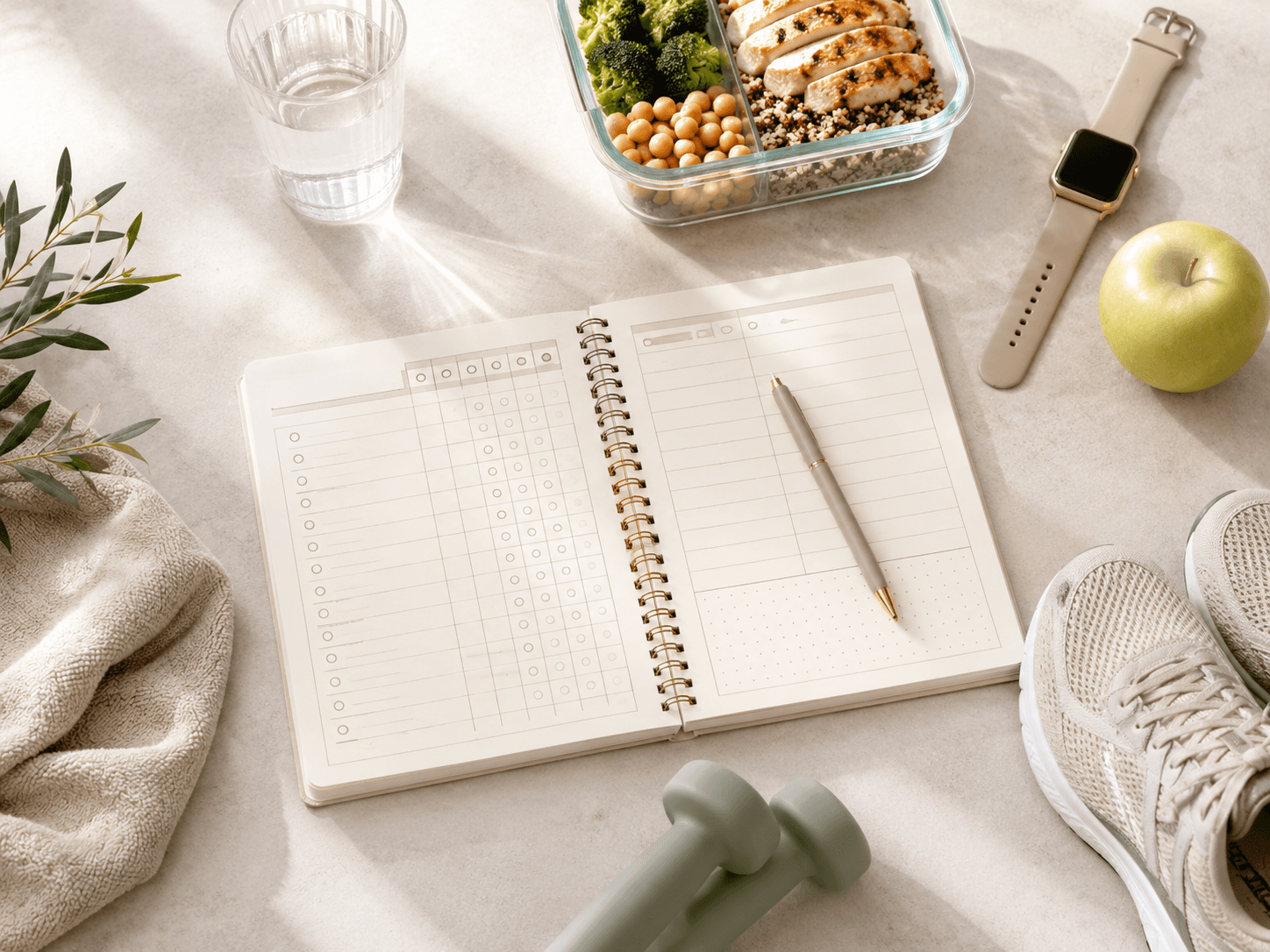
The difficult part is usually not knowing what to do. It is turning that knowledge into actions that can be repeated consistently in everyday life.
Lasting habits are rarely created through motivation alone. They are more likely to develop when a behaviour is specific, realistic, linked to a reliable cue and repeated in a similar context over time. With repetition, the behaviour may gradually require less conscious effort and begin to feel more automatic. [1,2]
Building habits does not mean following a routine perfectly. It means creating behaviours that are practical and flexible enough to return to, even after busy weeks, holidays or periods of lower motivation.
Key takeaways
- Choose a small, specific behaviour rather than a broad goal.
- Link the behaviour to a reliable time, place or existing routine.
- Make the desired action easier by reducing the steps needed to begin.
- Create a lower-effort version for difficult days.
- Use tracking as feedback rather than as a measure of success or failure.
- Focus on repetition and returning to the habit, rather than perfection.
What is a habit?
A habit is a behaviour that becomes associated with a recurring cue or context.
For example:
- preparing breakfast after making coffee
- taking a short walk after lunch
- filling your water bottle when you arrive at work
- planning the week’s dinners on Sunday afternoon
These behaviours may begin as conscious choices. When they are repeated in a similar situation, the surrounding context can gradually begin to prompt the behaviour with less deliberate thought. [1]
The aim is not to remove conscious choice completely. It is to make a helpful behaviour easier to begin and less dependent on motivation, memory or willpower.
Goals and habits are different
A goal describes an outcome you would like to achieve.
Examples include:
- improve fitness
- eat more vegetables
- feel more organised around food
- reduce takeaway meals
A habit is a repeated action that may help move you towards that goal.
Examples include:
- walk for 15 minutes after dinner
- add one vegetable to lunch
- pack lunch while cleaning up after dinner
- prepare one freezer meal each Sunday
Goals provide direction, but habits describe what you will actually do.
“Eat more healthily” may be meaningful, but it is difficult to repeat because it does not specify an action. “Add a piece of fruit to my work bag each morning” is clear, observable and practical.
Why motivation is not enough
Motivation naturally changes.
It can be influenced by:
- sleep
- stress
- workload
- mood
- illness
- competing priorities
- how enjoyable the behaviour feels
- whether progress is happening quickly
A plan that relies on feeling motivated every day may work during calm periods but become difficult when life gets busy.
Habits reduce this reliance by linking a behaviour to a predictable cue or routine. Research suggests that repeatedly performing a behaviour in a stable context strengthens the association between the context and the action. [1,2]
Motivation may help you begin. Planning, repetition and environment help the behaviour continue.
1. Choose one clearly defined behaviour
Broad intentions are difficult to act on consistently.
Compare:
Broad intention:
“I want to eat better.”
Specific behaviour:
“I will add a serve of vegetables to my lunch on weekdays.”
Another example:
Broad intention:
“I need to exercise more.”
Specific behaviour:
“I will walk for 15 minutes after dinner on Monday, Wednesday and Friday.”
A useful habit should answer:
- What will I do?
- When will I do it?
- Where will I do it?
- How often will I do it?
The clearer the behaviour is, the easier it becomes to repeat and review.
2. Start smaller than you think you need to
A common mistake is building a habit around an ideal week rather than a normal one.
Someone who is currently doing no structured exercise may aim to train for an hour six days per week. Someone who rarely cooks may decide to prepare every meal from scratch.
Large changes may work temporarily, but they also require more time, energy and organisation. When the starting point is too demanding, one difficult week can cause the entire plan to stop.
A smaller action creates more opportunities for repetition.
For example:
- prepare one lunch rather than every lunch
- walk for 10 minutes rather than immediately aiming for an hour
- include vegetables at one meal rather than changing the whole day
- plan three dinners rather than seven
A small habit is not necessarily the final goal. It is the starting point.
Once the behaviour feels more established, it can be gradually expanded.
3. Attach the habit to a reliable cue
A cue is something that prompts the behaviour.
It may be:
- a time of day
- a place
- another behaviour
- an object
- a reminder
- a transition between activities
Examples include:
- After I make my morning coffee, I will prepare breakfast.
- When I finish lunch, I will walk for 10 minutes.
- When I unpack the groceries, I will wash two vegetables.
- After dinner, I will pack tomorrow’s lunch.
Plans that specify when and where a behaviour will occur are sometimes called implementation intentions or “if–then” plans.
For example:
If I finish dinner, then I will pack tomorrow’s lunch before leaving the kitchen.
Research suggests that implementation intentions can help translate intentions into action, including for healthy eating and physical activity. [3,4]
The most useful cue is one that happens reliably and at a time when the behaviour is genuinely possible.
4. Make the desired behaviour easier
Many habits fail not because someone lacks commitment, but because the action requires too many steps at the moment it needs to happen.
Reducing friction means removing unnecessary barriers.
For meal preparation
- Keep several simple meals available.
- Use frozen vegetables or pre-cut ingredients.
- Cook additional portions for another day.
- Decide on dinner before becoming very hungry.
- Keep commonly used foods visible and accessible.
For physical activity
- Place walking shoes near the door.
- Prepare exercise clothes the night before.
- Choose a realistic time and location.
- Keep a shorter backup workout available.
For hydration
- Carry a water bottle.
- Keep it visible at your desk.
- Refill it at a consistent time.
- Pair drinking water with meals or breaks.
The environment can either support the behaviour or repeatedly make it harder.
Changing the environment is not cheating. It is part of creating a routine that works in real life.
5. Make unhelpful behaviours less automatic
The same principle can be used in reverse.
Rather than relying on restraint in the moment, add a small amount of friction to behaviours you want to reduce.
For example:
- serve snacks into a bowl rather than eating from the packet
- store discretionary foods somewhere less visible
- turn off food-delivery notifications
- avoid working beside an open packet of food
- keep your phone away from the bed if it interferes with sleep
The aim is not to ban foods or create a rigid environment. It is to reduce automatic decisions that do not align with what you intended.
6. Create a minimum version for difficult days
A habit is more likely to last when it includes a lower-effort version.
For example:
- Preferred version: Complete a 45-minute strength session. Minimum version: Complete 10 minutes or the first two exercises.
- Preferred version: Cook dinner from scratch. Minimum version: Use a supermarket chicken, microwave rice and frozen vegetables.
- Preferred version: Prepare a salad bowl for lunch. Minimum version: Pack a sandwich, yoghurt and fruit.
- Preferred version: Walk for 30 minutes. Minimum version: Walk for 10 minutes.
The minimum version keeps some connection with the intended routine without requiring ideal circumstances.
This can also reduce all-or-nothing thinking, where a behaviour is considered worthwhile only when it can be completed perfectly.
7. Use tracking as feedback
Self-monitoring can involve:
- ticking a calendar
- recording exercise sessions
- checking off planned meals
- using a habit-tracking app
- writing a brief weekly reflection
Self-monitoring can improve awareness and has been used effectively in many health-behaviour interventions. However, it is most useful when the information leads to reflection and adjustment rather than guilt. [5,6]
The purpose is not to prove that you were “good” or “bad.”
It is to notice patterns such as:
- The habit works on weekdays but not weekends.
- Evening exercise is regularly missed because work finishes late.
- Lunch is easier to prepare when dinner leftovers are available.
- The behaviour is too large for the time currently available.
Tracking should be simple. A single tick may provide enough information.
8. Review the system, not your character
When a habit is not happening, people often conclude that they are lazy, unmotivated or lacking discipline.
A more useful response is to review how the habit was designed.
Ask:
- Was the action specific?
- Was the cue reliable?
- Was the behaviour small enough?
- Was there enough time?
- Were the required foods or equipment available?
- Did the plan depend on an unusually good day?
- Would a different time or setting work better?
For example:
“I never prepare lunch because I have no discipline.”
could become:
“I plan to prepare lunch in the morning, but mornings are rushed. I will pack it while cleaning up after dinner instead.”
This changes the focus from self-criticism to problem-solving.
9. Choose habits that provide some immediate benefit
Many health goals offer delayed rewards. Improvements in fitness, weight or long-term health may take time to become noticeable, while the effort of the behaviour occurs immediately.
Habits may be easier to repeat when the action also provides a short-term benefit or positive experience. Perceived reward and enjoyment may support habit formation. [7]
For example:
- choose a form of movement you enjoy
- listen to a podcast while walking
- prepare meals you genuinely like
- exercise with a friend
- notice immediate benefits such as improved mood, energy or reduced stress
This does not mean every healthy behaviour must feel effortless. It means that a plan based entirely on punishment, deprivation or obligation may be difficult to maintain.
How long does it take to form a habit?
The idea that every habit takes exactly 21 days is not supported by research.
The time required varies depending on:
- the behaviour
- the person
- how often it is repeated
- how consistent the context is
- how complex the action is
- whether interruptions occur
A recent systematic review found considerable variation in how long health-related behaviours took to become more automatic. It is more realistic to think in terms of repeated practice over weeks or months than a fixed deadline. [2]
A more useful question is:
Is the behaviour becoming easier to begin and more consistent within my routine?
What happens if you miss a day?
Missing one occasion does not erase a habit.
Habit formation depends on the broader pattern of repetition, not perfect performance.
After a missed occasion:
- Identify what interrupted the habit.
- Decide whether the plan needs adjusting.
- Avoid trying to compensate excessively.
- Return to the behaviour at the next realistic opportunity.
Missing one walk does not require a two-hour walk the following day. Ordering takeaway does not mean the entire week is ruined. Forgetting to prepare lunch does not mean meal planning has failed.
The skill is not avoiding every disruption. It is learning how to resume.
A simple habit-building plan
Choose one behaviour and complete the following.
The behaviour
What specific action will you take?
I will prepare a balanced lunch for work.
The cue
When will it happen?
After I clean up dinner.
The frequency
How often will you do it?
Sunday to Thursday evenings.
The preparation
What will make it easier?
I will keep lunch containers available and add lunch ingredients to my shopping list.
The minimum version
What will you do on a difficult day?
Pack a sandwich, fruit and yoghurt.
The review
When will you check whether the plan is working?
At the end of two weeks.
The bottom line
Habits that last are not usually created through stronger willpower.
They are more likely to develop when a behaviour is:
- specific
- realistic
- linked to a reliable cue
- easy enough to begin
- supported by the environment
- repeated consistently
- flexible enough to survive difficult days
Start with one small action and create the conditions that make it easier to repeat.
You do not need to perform the behaviour perfectly, and you do not need to change everything at once. The goal is to build a routine you can return to often enough that the helpful choice gradually becomes easier and more familiar.
A note on scope
This article provides general health information and is not a substitute for individual medical, dietetic or psychological advice.
References
- Wood W, Rünger D (2016). Annual Review of Psychology, 67:289–314. — Psychology of habit
- Singh B, Murphy A, Maher C, Smith AE (2024). Healthcare, 12(23):2488. — Time to form a habit: a systematic review and meta-analysis of health behaviour habit formation and its determinants
- Adriaanse MA, Vinkers CDW, De Ridder DTD, Hox JJ, De Wit JBF (2011). Appetite, 56(1):183–193. — Do implementation intentions help to eat a healthy diet? A systematic review and meta-analysis of the empirical evidence
- Kompf J (2020). Journal of Physical Activity and Health, 17(3):349–359. — Implementation intentions for exercise and physical activity: who do they work for? A systematic review
- Raber M, Liao Y, Rara A, et al. (2021). Public Health Nutrition, 24(17):5885–5913. — A systematic review of the use of dietary self-monitoring in behavioural weight-loss interventions: delivery, intensity and effectiveness
- Duckworth AL, Milkman KL, Laibson D (2018). Psychological Science in the Public Interest, 19(3):102–129. — Beyond willpower: strategies for reducing failures of self-control
- Judah G, Gardner B, Kenward MG, DeStavola B, Aunger R (2018). BMC Psychology, 6:62. — Exploratory study of the impact of perceived reward on habit formation